When Cities Start Thinking – Smart Cities Explained
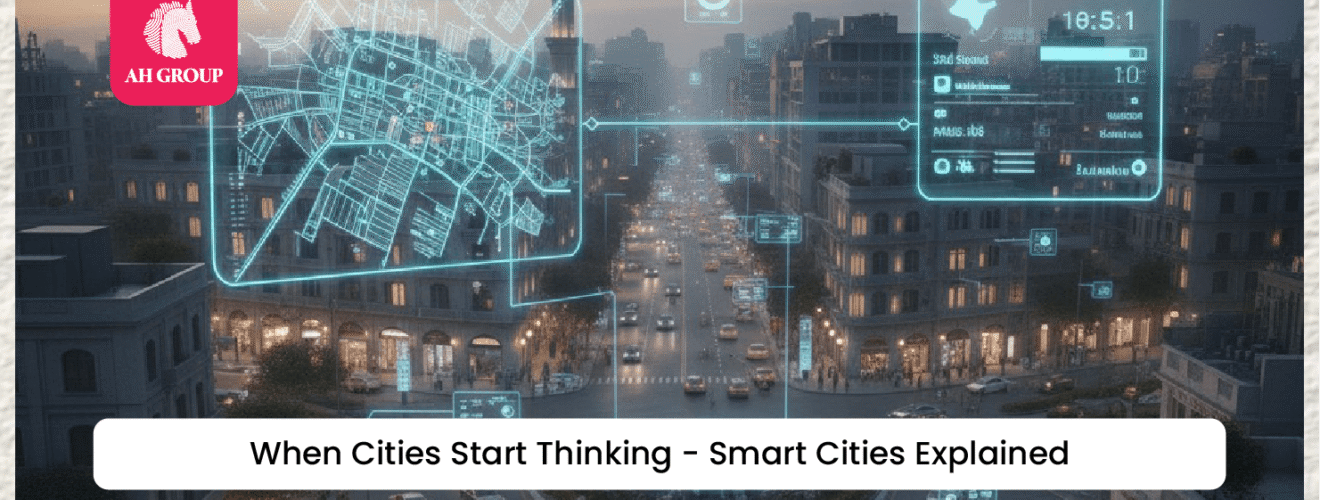
Imagine waking up in a city that is alive, the streetlights go off when no one is around, traffic lights change according to the actual traffic, bins remind people that they must be emptied, houses are powered at the lowest possible price, and all the things around you appear to be in harmony. This isn’t a science fiction story, this is the world of smart cities.
Urbanization increases the number of people, and the resources become scarce over time. A smart city does not consist of technology alone, it is an ecosystem that employs sensors, data, and artificial intelligence to make the existing systems in everyday life, like transport, energy, water, and safety, more efficient and sustainable.
How Cities Get Smart
Think of a smart city as a living body. Sensors can be seen as nerves, data is blood, and AI is the brain, which will assist it in sensing, responding, and evolving.
The real-time information from the cameras and sensors adjusts traffic lights, alleviates congestion, and decreases emissions. In China, Alibaba’s City Brain manages traffic flows and has reduced congestion by approximately 15%.
Energy systems are changing as well. Smart grids manage demand and supply, store the redundant power, and even tap into local renewable sources such as solar and wind. The buildings also learn through the consumption pattern, and they make use of intelligent lighting systems and climate systems to conserve energy. Waste and water systems are even becoming smart, i.e., bins that indicate when they are full and water sensors that can very early identify a leak.
However, an intelligent city does not just automate, but it listens. Technology collaborates with citizens, utilizing apps to report and request services and participate in local decision-making.
Myths, Misconceptions, and Surprises
A lot of people believe that smart cities are not meant for poor countries, but that is not the case. The most common case is that many projects begin small and then expand as costs of technology drop, either with simple sensors or local data projects.
Another concern is privacy. Although the use of smart systems can cause concern over surveillance, effective governance, transparency, and protection of data can help make certain that the technology is a service to people rather than a spy on them.
Some visualize smart cities as a futuristic flying taxi and robot world. Most innovation is, in fact, low-keyed: the efficient energy system, the adaptive lighting, the predictive maintenance.
And some beautiful surprises, too, are there:
- Electric cars that pay a fee when using the road
- Streetlights, which also act as Wi-Fi hotspots or air-quality devices
- A 15-minute city, where you can walk or ride your bike to everything you need within a 15-minute distance
- Whole districts fully powered by renewable energy, such as the Bo01 project of Malmö
These examples indicate that the revolution of the smart city is already taking place, one innovation at a time.
Lessons from Around the World
Global examples of smart cities can help minimize common mistakes and build an efficient system.
- Singapore, with the Smart Nation program connecting transport, planning, and public services based on data, and addressing the challenges of privacy and equity
- Barcelona specializes in individuals using real-time applications and open data, combining technology and social inclusion.
- Songdo, South Korea, is a completely smart, efficient, and infrastructure-rich urban area, but it sometimes fails to give people a sense of living in a community.
- Masdar City, UAE, is a scaling project meant to go zero carbon, but it is costly, and it demonstrates the discrepancy between vision and reality.
The Road Ahead – Greener, Smarter, More Human
It is not that true smart cities are all about surveillance and cold efficiency, but rather about the increase in human potential. A smart city does not control its people but rather listens, adapts, and responds to its people.
The future lies in collaboration, all governments, companies, universities, startups, and citizens will take part. It lies in resilience, cities capable of dealing with climate shocks, demand peaks, pandemic, and finally, it lies in evolution, systems capable of learning and adapting. Reliability should also be sustained and not added. The smart solutions must decrease carbon emissions, improve water management, create green spaces, and be walkable.
Smart cities are not all about technology but rather about creating the places that can think, change, and eventually, enable the people who call them home to live better.