
Your Simple Guide to Becoming a Tax Filer and Saving Millions on Property Tax

Imagine leaving millions of rupees on the table every time you buy or sell an asset. In Pakistan today, that is the shocking reality for anyone who remains a non-filer with the Federal Board of Revenue (FBR). The government has radically changed the rules, transforming the property tax landscape. Compliance is no longer just a legal obligation; it is immediate financial self-defense.
This report reveals exactly how simple it is to register and, more importantly, how much you save on every major transaction, especially when dealing with tax on property.
Why Being a Non-Filer is Financial Self-Sabotage
The tax net in Pakistan is closing rapidly. The reason is simple: a staggering tax gap of Rs. 7 trillion was recently reported by the FBR. To close this enormous shortfall, the government has pursued aggressive collection strategies, resulting in a robust 26.3 percent year-on-year growth in total revenues for the Financial Year 2024-25.
This achievement confirms that tax authorities are successfully tightening their grip, and the primary targets of this intensified effort are non-filers and those who delay compliance.
A tax filer is simply an individual registered with the FBR who files an annual Income Tax Return. By linking registration to your official identification and banking details, the FBR has created a system where major transactions are entirely traceable.
For the average investor or homeowner, ignoring this process means subjecting yourself to punitive taxes on every major transaction, particularly when buying or selling real estate. This massive disparity in property tax in pakistan can easily cost millions, making compliance mandatory for anyone concerned about their financial well-being.
A Simple Plan to Become a Tax Filer
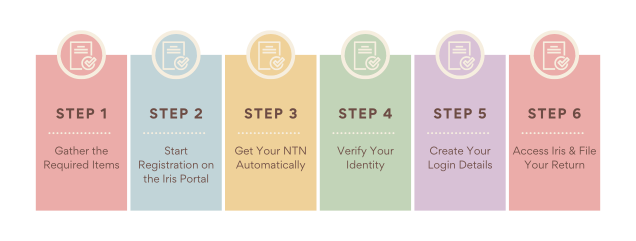
The process of becoming a tax filer is straightforward and can be completed online through the FBR’s digital platform, the Iris Portal. The low administrative barrier stands in sharp contrast to the high financial cost of non-compliance.
Step 1: Gather the Required Items
Before you start, make sure you have:
- Your original CNIC
- A mobile number registered in your own name
- Your personal email address
- A bank account certificate (showing you have an account in your name)
- If registering a business: proof of rent/ownership of the business location + a paid utility bill from the last 3 months
Step 2: Start Registration on the Iris Portal
- Go to the FBR Iris Portal online.
- Begin the E-Enrollment process.
Step 3: Get Your NTN Automatically
- Your 13-digit CNIC becomes your NTN (National Tax Number) automatically during registration.
Step 4: Verify Your Identity
You’ll receive:
- A verification code on your email
- A One-Time Password (OTP) on your mobile number
- Enter both to continue.
Step 5: Create Your Login Details
- Set a new password
- Create a 4-digit PIN for account recovery
- Once done, your account is ready.
Step 6: Access Iris & File Your Return
- Log in to the Iris Portal.
- You can now file your Income Tax Return online.
Why It Matters
Becoming a filer gives you much lower tax rates, especially on things like property transactions and many other payments.
Paying 7X More Property Tax
Here is the most crucial part of this report. The government has strategically made immovable property tax the primary tool for forcing registration. If you are buying property, you are required to pay Advance Income Tax under Section 236K. This is the core property purchase tax in pakistan. The difference between what a Filer pays and what a Non-Filer pays is astonishing.
The tax rates are progressive, increasing based on the property’s Fair Market Value or FMV. For a buyer of immovable property valued above Rs. 100 million, the advance income tax under Section 236K is 2.5 percent for an active filer and 18.5 percent for a non‑filer. This means the non‑filer pays 7.4 times as much advance tax as the filer, a 16‑percentage‑point difference that can amount to many millions of rupees on large transactions.
Furthermore, the FBR has introduced a ‘Late-Filer’ category. This means even if you are registered but miss the annual income tax return filing deadline, you are penalized with rates that are three times higher than those of regular filers, although still lower than true Non-Filers. This structure reinforces that timely compliance is essential to avoid steep surcharges.
Table 1: Advance Income Tax on Property Purchase (Section 236K) – Buyer
| Property Fair Market Value | Filer Rate | Late-Filer Rate | Non-Filer Rate (The Penalty) |
| Up to Rs. 50 Million | 1.5% | 4.5% | 10.5% |
| Rs. 50M to Rs. 100 Million | 2.0% | 5.5% | 14.5% |
| Over Rs. 100 Million | 2.5% | 6.5% | 18.5% |
This extreme disparity for high-value purchases shows that the government is intentionally using the property tax sector as a control point to ensure wealthy individuals formalize their income. When millions of rupees are at stake on a single purchase, registration moves from an optional chore to a financial imperative.
Protecting Your Profit: Tax on Sale of Property
The urgency does not end with the buyer; the seller faces equally severe penalties on the tax on sale of property.
Advance Tax on Property Sale (Section 236C)
When selling immovable property, the seller must pay Advance Income Tax under Section 236C. This tax is based on the gross consideration received and the seller’s filer status. For filers, the rates are progressive, ranging from 4.5 percent to 5.5 percent. However, Non-Filers selling tax on property pay a flat rate of 11.5 percent across all transaction tiers.
Table 2: Advance Income Tax on Property Sale (Section 236C) – Seller
| Gross Consideration Received | Filer Rate | Late-Filer Rate | Non-Filer Rate (The Penalty) |
| Up to Rs. 50 Million | 4.5% | 7.5% | 11.5% |
| Rs. 50M to Rs. 100 Million | 5.0% | 8.5% | 11.5% |
| Over Rs. 100 Million | 5.5% | 9.5% | 11.5% |
The Capital Gains Tax Threat
Beyond this advance tax, the seller is also liable for Capital Gains Tax or CGT on the profit earned. For many recent property and securities transactions, filers often face capital gains tax at or around 15%, while non‑filers are either taxed at higher fixed CGT rates or at normal income‑tax slab rates that can push their effective tax on gains up to roughly 45%, depending on income and holding period.
This situation is made even more precarious by a recent proposal that, for property acquired on or after 1 July 2024, would effectively abolish traditional holding‑period relief, keeping such assets fully exposed to capital gains tax regardless of how long they are held.
Previously, investors could benefit from lower tax rates if they held the property for a longer period. With this exemption potentially gone, all profit is taxed regardless of how long the property was held, making filer status essential to minimize the final tax on property sale in pakistan bill.
The combined effect of high advance tax (236C) and extreme CGT rates creates a hostile environment for unregistered property speculation. Non-filers severely restrict their market access, as a filer is always a more attractive transaction partner due to the lower total cost of transfer for both parties.
Tax Penalties Beyond Property
The punishment for non-compliance extends far beyond just property tax. The FBR uses a multi-layered approach, combining massive punitive taxes on large assets with recurring penalties on routine financial life.
For example, For cash withdrawals above the daily threshold (currently Rs 50,000, proposed to rise to Rs 75,000), filers pay no withholding tax, while non-filers pay a percentage (around 0.8%) on the amount exceeding the limit. This tax erodes liquidity and affects financial planning daily.
Moreover, non-filers face higher tax rates on vehicle registration and transfer. Failure to comply with registration obligations can also lead to severe fines under FBR regulations. Specific tax compliance failures can attract minimum penalties in the range of Rs. 10,000 (or more), and for some types of defaults the law also imposes an additional penalty for each day the non‑compliance continues, as specified in the relevant section.
On the other hand, being a compliant citizen makes managing your obligations easier. The FBR supports property tax online payment and other tax payments through Alternate Delivery Channels or ADC and e-Payment systems. Many provincial authorities also offer convenient portals for provincial property tax online payments. Filing status simplifies these administrative tasks significantly.
Securing Your Future Through Compliance
Becoming a registered tax filer is one of the most impactful financial steps you can take to protect your assets and future investments. It can save you up to 7.4 times the advance tax on large property purchases and roughly halve or better the advance tax you pay when selling property, depending on the transaction size.
Do not remain a Non-Filer and subject your capital to confiscatory rates. Do not risk becoming a Late-Filer and paying triple the amount. Take the simple steps outlined above, register on the FBR Iris portal, and immediately secure the vast financial benefits that come with tax compliance. The difference between 2.5 percent and 18.5 percent property tax is the cost of your hesitation.